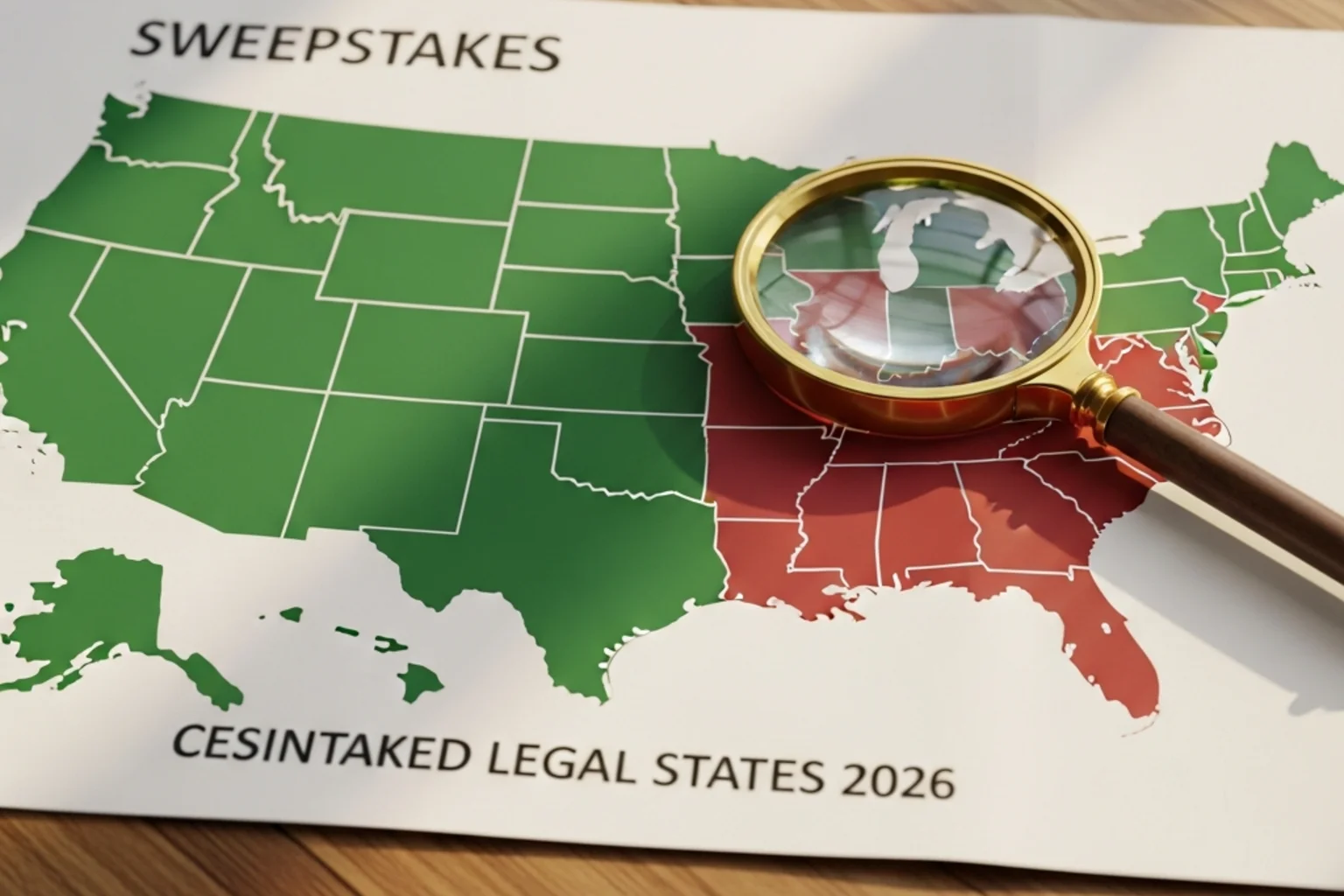
The legal landscape for sweepstakes casinos fractured dramatically between 2025 and 2026. What was once a largely unregulated industry operating across most of the United States now faces active bans in multiple states, aggressive enforcement actions in others, and pending legislation threatening further restrictions.
In late 2025, the New York Attorney General sent cease-and-desist letters to 26 sweepstakes casino operators, forcing all of them to halt Sweeps Coin sales to New York residents. That single enforcement action removed one of the largest state markets from the sweepstakes ecosystem overnight. Similar actions followed in California, Montana, New Jersey, Connecticut, and West Virginia, creating a patchwork of prohibitions that players must now navigate.
Understanding sweepstakes casino legal states in 2026 requires tracking both formal legislation and regulatory enforcement. Some states passed explicit bans with criminal penalties. Others achieved similar results through attorney general actions, gaming commission orders, or settlement agreements that forced operators to exit. The practical effect—no legal access to sweepstakes casinos—remains identical regardless of the mechanism.
This guide maps the current legal status of sweepstakes casinos across all 50 states, documenting active bans, enforcement actions, and jurisdictions where platforms continue operating. Laws change rapidly in this space, and what’s accurate today may shift within months. Consider this a starting point for understanding your state’s status, not a permanent legal reference.
States with Active Bans as of January 2026
Five states have enacted formal legislative bans on sweepstakes casinos, with penalties ranging from civil fines to felony charges. These aren’t cease-and-desist actions or regulatory interpretations—they’re laws specifically criminalizing sweepstakes casino operations and, in some cases, participation.
Montana: The First Domino
Montana became the first state to legislatively ban sweepstakes casinos when Governor Greg Gianforte signed SB555 into law. The legislation took effect in October 2025, making Montana the national test case for sweepstakes prohibition. Penalties under SB555 are severe: felony charges with fines up to $50,000 and prison sentences up to 10 years per offense for operators.
The Montana ban emerged from concerns about unlicensed gambling competing with regulated gaming establishments. State legislators viewed sweepstakes casinos as evading gambling laws through semantic gamesmanship—offering what functions as gambling while claiming sweepstakes exemptions. The felony-level penalties signal how seriously Montana treats the distinction.
For players, Montana’s ban means no legal access to sweepstakes casino platforms from within state borders. Major operators geo-blocked Montana users before the law took effect, and any platform still accepting Montana players does so in violation of state law—creating risk for both operators and users.
California: The Market Giant Falls
California’s AB831 represented the most economically significant sweepstakes ban to date. The state accounted for $2.42 billion in sweepstakes casino activity in 2025—approximately 17.3% of the entire U.S. market. Governor Gavin Newsom signed AB831 in October 2025, with enforcement beginning January 2026.
AB831 classifies sweepstakes casino operation as a misdemeanor, with penalties of $1,000 to $25,000 per violation and up to one year imprisonment. The law extends liability to vendors and service providers supporting sweepstakes platforms, creating broader legal exposure than operator-only bans.
California’s ban reflects pressure from tribal gaming interests, which hold exclusive rights to casino-style gambling under state compacts. Tribes argued that sweepstakes casinos violated these exclusivity agreements by offering functionally identical gambling experiences outside regulatory frameworks. The ban protects tribal gaming revenue while eliminating what regulators characterized as unregulated gambling.
New York: Legislative Action Follows AG Enforcement
New York’s path to sweepstakes prohibition combined executive enforcement with legislative codification. The state formally banned sweepstakes casinos through S5935, which Senator Joseph Addabbo championed through the legislature. Addabbo articulated the legislative rationale: “If a game on your phone or computer looks like a casino game, acts like a casino game, and pays out real money winnings like a casino game, then it is a casino gambling game, thus currently illegal and should not operate in New York without proper regulation.”
S5935 imposes civil penalties of $10,000 to $100,000 per violation for operators. While penalties fall below Montana’s felony structure, they create substantial financial exposure for platforms attempting to maintain New York operations. Combined with the Attorney General’s earlier cease-and-desist campaign, the law effectively eliminated sweepstakes casino access for New York residents.
New Jersey: Protecting Regulated iGaming
New Jersey’s sweepstakes ban through A5447 carries the steepest civil penalties of any state: $100,000 for first offenses and $250,000 for subsequent violations. The law reflects New Jersey’s position as a regulated online gambling market—sweepstakes casinos competed directly with licensed iGaming operators subject to taxation and regulatory oversight.
A5447’s high penalty structure aims to make New Jersey operations economically unviable for sweepstakes platforms. State regulators positioned the ban as protecting consumers through the regulated gambling framework while eliminating unlicensed competition that avoided tax and compliance obligations imposed on legal operators.
Connecticut: Settlement as De Facto Ban
Connecticut achieved sweepstakes casino prohibition through enforcement action rather than legislation. The Department of Consumer Protection’s settlement with High 5 Games established precedent that sweepstakes platforms cannot legally operate in the state. While no specific ban statute exists, regulatory interpretation and enforcement effectively prevent sweepstakes casino access.
Major operators exited Connecticut following the High 5 settlement, treating DCP’s position as establishing state law regardless of formal legislative status. The practical result for Connecticut players matches banned states: no legal access to sweepstakes casino platforms.
States with Aggressive Enforcement Actions
Beyond formal bans, several states have pursued enforcement actions that achieved similar results through regulatory pressure. These states haven’t passed sweepstakes-specific legislation but have used existing gambling laws, attorney general authority, or gaming commission power to drive operators from their markets.
West Virginia: The Subpoena Campaign
West Virginia Attorney General JB McCuskey launched the most aggressive enforcement campaign against sweepstakes casinos seen in any state. His office issued 47 subpoenas to sweepstakes casino operators, demanding detailed information about their operations, player bases, and financial activities.
The subpoena campaign produced dramatic results. More than 40 sweepstakes platforms voluntarily exited West Virginia rather than comply with investigative demands or risk enforcement action. Platforms that remained operational face ongoing scrutiny and potential prosecution under existing gambling laws.
West Virginia Delegate Shawn Fluharty, president of the National Council of Legislators from Gaming States, articulated the enforcement philosophy driving these actions: “They look like a casino, talk like a casino, walk like a casino. And they’re trying to tell us they’re not a casino.” That perspective shapes how West Virginia regulators interpret sweepstakes operations—as gambling requiring licensure, not sweepstakes exempt from gaming law.
Connecticut: The High 5 Settlement
Connecticut’s Department of Consumer Protection reached a $1.5 million settlement with High 5 Games in May 2025, establishing precedent for sweepstakes casino enforcement. The settlement included $643,000 in consumer restitution and $800,000 for an enforcement fund to pursue additional operators.
The High 5 investigation revealed concerning patterns that informed Connecticut’s aggressive stance. DCP documented that 1,100 Connecticut users had accessed High 5 Casino, with 911 losing a combined $938,000. More troubling, 108 players on the state’s self-exclusion list for gambling problems had accessed the platform and lost approximately $300,000—highlighting sweepstakes casinos’ potential to reach vulnerable populations excluded from regulated gambling.
Following the settlement, High 5 Games exited Connecticut entirely. Other major operators followed, treating Connecticut as effectively banned regardless of formal legislative status. The DCP’s willingness to pursue enforcement, combined with settlement terms that included consumer restitution, signaled that sweepstakes casino operations carry serious legal risk in the state.
Arizona: Gaming Commission Orders
Arizona’s Department of Gaming issued multiple cease-and-desist orders to sweepstakes casino operators throughout 2025. While Arizona hasn’t passed sweepstakes-specific legislation, the Gaming Commission interpreted existing law to prohibit dual-currency gaming operations that function as unlicensed gambling.
The Arizona enforcement approach targeted specific operators rather than establishing blanket prohibitions. Platforms receiving cease-and-desist orders faced immediate compliance requirements; those continuing operations risked further enforcement action under state gambling statutes. Several major operators geo-blocked Arizona users in response.
Tennessee: Constitutional Prohibition
Tennessee’s constitution prohibits gambling, creating legal exposure for sweepstakes casinos operating in the state. Attorney General Jonathan Skrmetti took action against multiple sweepstakes operators, characterizing their operations as illegal gambling violating constitutional provisions.
Unlike states with regulatory ambiguity, Tennessee’s constitutional gambling prohibition leaves little interpretive flexibility. Sweepstakes casinos operating in Tennessee face not just regulatory risk but potential criminal prosecution under long-established anti-gambling law. Most major operators have geo-blocked Tennessee users in response to enforcement actions and constitutional risk.
States Where Sweepstakes Casinos Remain Legal
Despite the enforcement wave, sweepstakes casinos continue operating legally in the majority of U.S. states. These jurisdictions haven’t enacted specific bans, haven’t pursued aggressive enforcement, or have regulatory frameworks that accommodate sweepstakes operations under existing law.
States Without Significant Restrictions
Most states outside the banned and enforcement-action categories maintain permissive environments for sweepstakes casinos. Texas, Florida, Ohio, Pennsylvania, Virginia, Illinois, and Georgia all currently allow sweepstakes casino access. These states represent substantial population and market share—Florida alone contributes an estimated $1.04 billion in sweepstakes activity, representing 8.5% of the national market.
Legal operation in these states doesn’t mean sweepstakes casinos are explicitly legalized—rather, they operate without prohibition under existing sweepstakes law interpretations. The dual-currency model positions platforms as promotional sweepstakes rather than gambling, and state regulators haven’t challenged that characterization through enforcement action or legislation.
This permissive status may not be permanent. Several currently-accessible states have pending legislation or regulatory discussions that could change their approach. Players in these states have legal access now but should monitor legislative developments that might alter the landscape.
Idaho and Washington: Special Cases
Idaho and Washington have long prohibited sweepstakes casino operations, predating the 2025-2026 enforcement wave. These states took early positions against dual-currency gaming platforms, and major operators have geo-blocked both states for years.
Idaho’s prohibition stems from strict interpretation of gambling statutes that encompasses sweepstakes casino operations. Washington’s approach similarly views sweepstakes casinos as unlicensed gambling operations. Neither state participated in the recent ban wave because they achieved prohibition years earlier.
Nevada: The Ironic Exclusion
Nevada, home to Las Vegas and the country’s largest gambling market, doesn’t permit sweepstakes casinos. This seeming paradox reflects Nevada’s protective approach to its regulated gambling industry—sweepstakes platforms compete with licensed casinos without meeting the same regulatory requirements or tax obligations.
Major sweepstakes operators have never offered services in Nevada, treating the state as off-limits regardless of formal legal status. The concentration of gambling industry political power in Nevada makes sweepstakes legalization extremely unlikely, and operators apparently see no strategic value in challenging Nevada’s established framework.
States with Ambiguous Status
Several states occupy uncertain territory between clear legality and explicit prohibition. Michigan, for example, has robust regulated online gambling but hasn’t specifically addressed sweepstakes casinos through legislation or enforcement. Some operators offer services in these states; others geo-block them as a precaution.
Players in ambiguous jurisdictions face practical challenges: determining which platforms accept their state, assessing legal risk levels, and monitoring regulatory developments that might suddenly change access. The safest approach involves checking individual platform availability rather than assuming access based on neighboring state status or general legal assessments.
Pending Legislation to Watch
The 2026 legislative season features sweepstakes casino bills in multiple states, suggesting the current enforcement wave may continue expanding. Several states with large player bases have active bills that could eliminate access if passed.
Pennsylvania and Virginia: SGLA Target States
The Social Gaming Leadership Alliance has identified Pennsylvania and Virginia as priority states for industry advocacy, recognizing that both face potential legislative action. Pennsylvania generates an estimated $446 million in annual sweepstakes activity (3.6% of the U.S. market), while Virginia contributes approximately $423 million (3.4%). Both represent substantial revenue that operators want to protect.
Pennsylvania’s existing regulated online gambling market creates pressure similar to what drove New Jersey’s ban—licensed operators arguing that sweepstakes casinos compete unfairly by avoiding tax and regulatory obligations. Bills have been introduced that would classify sweepstakes casinos as unlicensed gambling, though none had passed as of early 2026.
Virginia lacks regulated online gambling, but legislators have proposed sweepstakes restrictions as part of broader gambling policy discussions. The state’s approach remains uncertain, with competing bills that would either ban or regulate sweepstakes operations.
Maryland: Active Bills
Maryland has seen multiple sweepstakes-related bills in its 2026 legislative session, reflecting ongoing tension between regulated gambling interests and sweepstakes operators. The state’s significant gambling industry—including casinos and sports betting—creates natural opposition to unregulated competitors.
Bills in Maryland have proposed various approaches: outright bans, regulatory frameworks that would bring sweepstakes under gaming commission oversight, and intermediate positions that would impose requirements without full prohibition. Legislative outcomes remain uncertain, but active attention signals that Maryland’s current permissive status may not last.
Florida: High Stakes Uncertainty
Florida represents perhaps the largest remaining market for sweepstakes casinos, with over $1 billion in annual activity. The state’s gambling politics involve complex relationships between the Seminole Tribe, commercial gambling interests, and state legislators—any of which could shift attention toward sweepstakes regulation.
No specific sweepstakes ban legislation has advanced in Florida, but the state’s size makes it an obvious target for future restriction. Industry observers watch Florida closely for signals that enforcement or legislative action might emerge.
Tracking Legislative Development
Players concerned about potential restrictions should monitor state legislature websites, industry news sources, and gaming-focused publications for updates. Bills move quickly once they gain momentum, and states can shift from permissive to banned status within a single legislative session. The California ban, for example, moved from bill introduction to signed law within months.
Penalties Comparison by State
States that have banned sweepstakes casinos impose varying penalties, from civil fines to criminal charges. Understanding these penalty structures reveals how seriously different jurisdictions treat sweepstakes operations—and the relative risk levels for anyone attempting to operate or access these platforms where prohibited.
Montana: Criminal Felony
Montana’s SB555 imposes the harshest penalties in the country. Operating a sweepstakes casino in Montana constitutes a felony offense. Convicted operators face fines up to $50,000 per violation and imprisonment up to 10 years per offense. Multiple violations compound these penalties, creating existential legal risk for any platform targeting Montana users.
The felony classification distinguishes Montana from states treating sweepstakes operations as civil violations or misdemeanors. Felony records carry lasting consequences beyond immediate penalties—affecting employment, housing, and civil rights. Montana legislators clearly intended these severe consequences to deter any sweepstakes activity within state borders.
California: Misdemeanor with Escalating Fines
California’s AB831 classifies sweepstakes casino operation as a misdemeanor. First offenses carry fines of $1,000 to $10,000. Subsequent violations escalate to $10,000 to $25,000 per offense. Operators can also face up to one year imprisonment.
AB831’s liability extension to vendors and service providers increases the law’s effective reach. Payment processors, advertising platforms, software providers, and others supporting sweepstakes operations face potential liability alongside operators. This broad approach aims to make California operations difficult by cutting off supporting infrastructure.
New Jersey: Steep Civil Penalties
New Jersey’s A5447 imposes civil rather than criminal penalties but sets them at levels designed to eliminate economic viability. First violations cost $100,000; subsequent violations jump to $250,000 each. These amounts exceed most states’ criminal fines, making New Jersey one of the most expensive jurisdictions for compliance failures.
The civil structure means operators face financial penalties rather than imprisonment, but the amounts involved create substantial deterrence. A platform caught operating in New Jersey after the ban could face multi-million-dollar liability from accumulated violations.
New York: Graduated Civil Fines
New York’s S5935 establishes civil penalties ranging from $10,000 to $100,000 per violation. The graduated structure allows enforcement to calibrate penalties based on violation severity, operator size, or other factors. While lower than New Jersey’s flat penalties, accumulated violations can still create significant financial exposure.
Practical Implications for Players
Current ban legislation targets operators rather than individual players. No state has enacted penalties specifically for users accessing sweepstakes casinos from banned jurisdictions. However, platforms geo-block banned states for operator protection, making access difficult regardless of user-side legal risk.
Using VPNs or other circumvention methods to access sweepstakes casinos from banned states violates platform terms of service and could forfeit winnings or account balances. While criminal prosecution of individual users seems unlikely under current law, the practical risks of circumvention often exceed any benefit from maintaining access.
What This Means for Players
The regulatory fragmentation of the sweepstakes casino market creates practical challenges for players beyond simple questions of legal access. Account portability, redemption timelines, and platform stability all intersect with the changing legal landscape.
Existing Balances and Account Access
Players with accounts and balances on platforms that subsequently exit their state face varying outcomes. Some platforms have allowed balance redemption during exit grace periods. Others have frozen accounts entirely, leaving players with inaccessible funds. The lack of regulatory standardization means no guaranteed protections exist for players caught in state-exit transitions.
If you play on sweepstakes platforms, maintaining low balances reduces exposure to sudden state exits. Redeeming Sweeps Coins regularly rather than accumulating large balances protects against both platform-side issues and regulatory changes that might affect access.
Verification and Redemption Complications
State restrictions complicate redemption processes even for players with legal access. Platforms implementing geo-blocking may require additional verification steps that delay payouts. Address changes, travel, or other factors that affect location verification can create temporary access issues even in legal states.
The fragmented legal landscape also affects platform willingness to process large redemptions. Some operators have reportedly increased scrutiny of large payout requests from states adjacent to banned jurisdictions, creating delays even for legitimate players in legal states.
Platform Reliability Concerns
The enforcement wave has pressured sweepstakes casino business models. Platforms losing major state markets—California alone represented 17% of industry activity—must adjust operations to reduced revenue bases. Some smaller operators may exit the market entirely; others might reduce service quality or delay payouts as they restructure.
The enforcement wave has created uncertainty across the industry. Larger operators with substantial financial reserves can absorb market losses from banned states more easily than smaller platforms operating on thin margins. Some smaller operators may exit entirely or reduce service quality as revenue contracts. Researching platform payout histories and financial stability before committing funds becomes more important in this environment.
Staying Compliant
The simplest approach to sweepstakes casino legality involves respecting geo-blocks and not attempting circumvention. If a platform doesn’t accept players from your state, that reflects the operator’s legal assessment of your jurisdiction’s status. Attempting access through VPNs or false location information creates practical risks—forfeited winnings, banned accounts, and potential terms-of-service violations—that exceed any entertainment value.
Players who relocate between states should update platform profiles promptly and verify continued access from new locations. Moving from a legal to a banned state may require closing accounts and withdrawing balances before relocation affects access.
Stay Informed
Sweepstakes casino legal states in 2026 represent a moving target. Montana, California, New York, New Jersey, and Connecticut have achieved effective prohibition through legislation or enforcement. West Virginia, Arizona, and Tennessee have pursued aggressive actions that drove most operators from their markets. Numerous other states have pending legislation that could change their status.
The legal situation will continue evolving throughout 2026 and beyond. Industry groups advocate for regulatory frameworks that would legitimize sweepstakes operations; gaming commissions and attorneys general push for restrictions protecting licensed gambling and consumer interests. Neither side has achieved definitive resolution.
For players, the practical approach involves checking individual platform availability for your state, maintaining reasonable account balances that reduce exposure to sudden changes, and monitoring news about legislation or enforcement that might affect your access. The sweepstakes casino market that existed in 2024 has already fragmented significantly, and further changes seem likely as regulatory attention continues.