
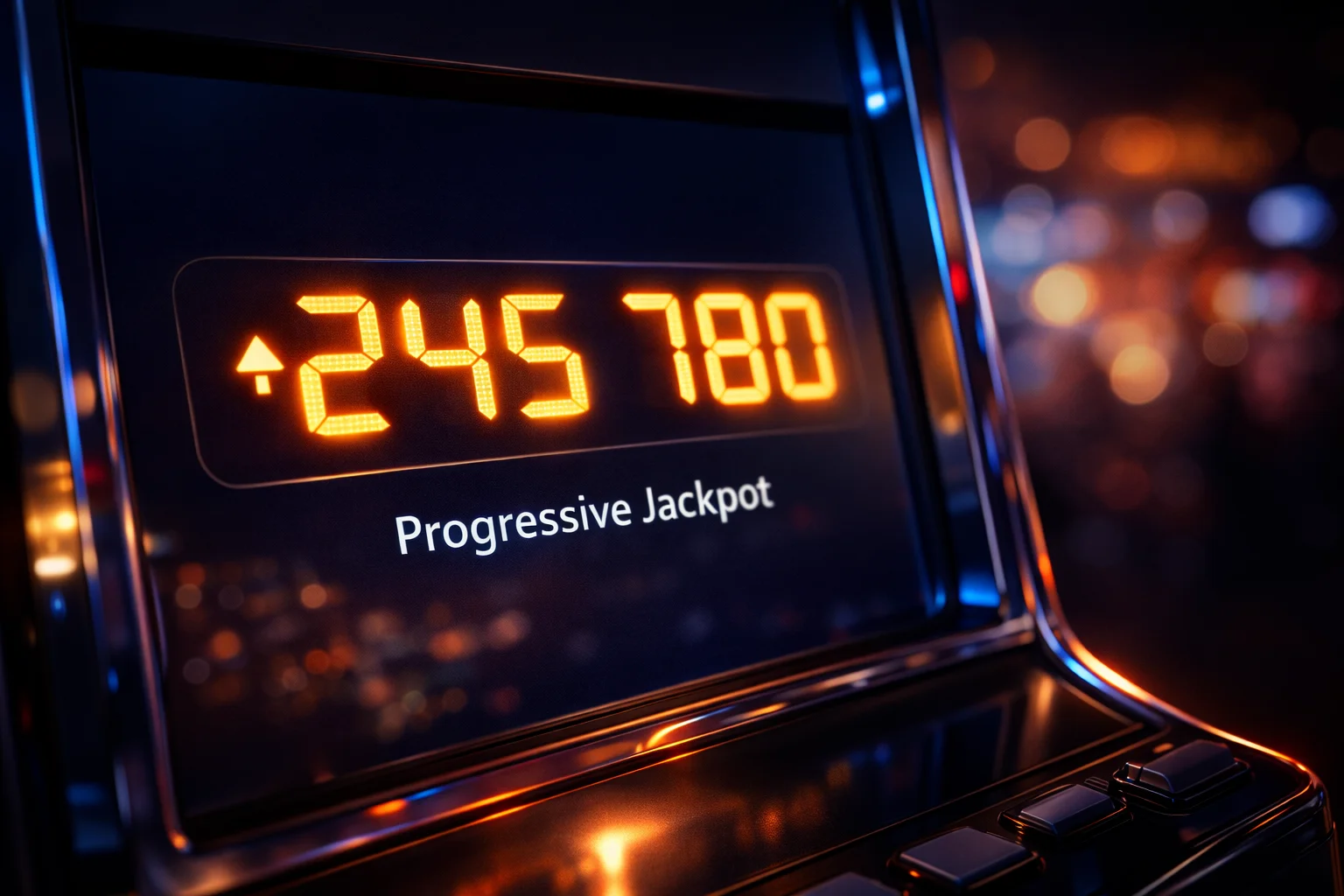
Every spin you take on a progressive slot adds to a prize pool that someone, eventually, will win. That mechanism transforms an ordinary slot into something with genuine tension: a jackpot that climbs in real time, displayed on screen like a financial ticker counting toward an unknown destination.
Understanding how progressive jackpots work separates informed players from those who chase numbers without grasping the system behind them. The sweepstakes casino market generated $10 billion in sales during 2024, and a significant portion of that activity flows through progressive games. Players watch jackpot counters climb past six figures, sometimes seven, without understanding the contribution rates, seed values, or trigger conditions that govern those growing totals.
This guide breaks down the complete mechanics of progressive jackpots as they operate at sweepstakes casinos. We’ll cover contribution percentages, the differences between standalone and network progressives, and the specific ways trigger systems determine when jackpots hit. The goal isn’t to promise winning strategies—progressive jackpots remain fundamentally random events with long odds—but to explain the machinery so you understand exactly what happens with every spin you make.
Progressive slots at sweepstakes casinos operate under the same mathematical principles as their real-money counterparts, but the dual-currency model introduces specific considerations worth understanding before you play.
How Progressive Jackpots Work — More on this topic at progressive sweep slots.
The Contribution System Explained
The contribution system forms the engine that makes progressive jackpots grow. Every qualifying bet feeds a percentage of its value into the jackpot pool, creating the climbing numbers that define progressive play. This isn’t magic—it’s arithmetic applied consistently across thousands of spins.
Most progressive slots allocate between 1% and 5% of each wager to the jackpot pool, though the exact figure varies by game and provider. A slot with a 3% contribution rate takes three cents from every dollar wagered and adds it to the progressive total. Spin enough reels across enough players, and those cents compound into substantial sums.
The contribution rate directly affects base game returns. A slot with a 96% theoretical RTP might show an effective RTP of 93% during play because that missing 3% feeds the progressive. You’re essentially trading consistent smaller returns for the possibility of an outsized payout. Whether that trade makes sense depends on your goals and bankroll tolerance.
How Contributions Divide Across Jackpot Tiers
Many progressive slots feature tiered jackpots—mini, minor, major, and grand—each receiving different contribution percentages. A typical allocation might send 0.5% to the mini jackpot, 0.75% to minor, 1% to major, and 1.5% to the grand. These ratios remain constant, but the outcome distributions differ dramatically.
Lower-tier jackpots hit more frequently because they require less accumulation to reach trigger thresholds. The mini jackpot might pay out every few hundred spins across all players, while the grand jackpot could require millions of spins before someone triggers it. Higher contribution percentages to top tiers mean faster growth but correspondingly longer odds.
Some games display these contribution rates transparently in their help screens. Others keep the percentages proprietary, revealing only that “a portion of each bet contributes to the jackpot.” When transparency exists, use it. Knowing whether a game contributes 2% or 4% to its progressive tells you something meaningful about the trade-off you’re accepting.
Bet Size and Contribution Scaling
Contribution amounts scale with bet size on most progressive slots. Betting $1 per spin at a 3% contribution rate adds three cents to the jackpot. Betting $5 per spin at the same rate adds fifteen cents. Larger bets accelerate jackpot growth and, on many games, improve your odds of triggering the progressive.
Some progressives require maximum bets to qualify for the top jackpot tier. Others allow any bet size to trigger any tier, though larger bets typically carry higher trigger probabilities. Check game rules before playing—nothing deflates enthusiasm faster than spinning into a jackpot trigger symbol at minimum bet and learning you qualified only for the mini tier.
The contribution system means progressive slots inherently carry lower base-game returns than equivalent non-progressive titles. That’s the fundamental trade-off: steady wins versus jackpot potential. Understanding this trade-off helps you select games that match your actual preferences rather than chasing jackpot numbers without recognizing the cost.
Seed Amounts and Reset Values
When someone wins a progressive jackpot, the counter doesn’t drop to zero. It resets to a predetermined amount called the seed value—a guaranteed minimum that exists even when the jackpot has just paid out. Understanding seed values reveals information about game economics and helps identify potentially favorable playing conditions.
Seed values represent money the casino or game provider fronts to ensure progressives always display an attractive number. A progressive with a $10,000 seed starts every cycle at that amount, regardless of how long it takes player contributions to push the total higher. The provider absorbs this cost as a marketing expense, betting that visible jackpot numbers drive enough play volume to offset the seed investment.
The relationship between seed values and current jackpot amounts matters more than most players realize. A progressive showing $50,000 with a $10,000 seed has accumulated $40,000 in player contributions. That same $50,000 display on a progressive with a $40,000 seed contains only $10,000 in contributions. The difference affects both jackpot growth rates and theoretical player value.
Why Reset Timing Creates Perceived Patterns
Immediately after a jackpot hits, the progressive resets to its seed and begins accumulating again. Some players avoid “recently reset” progressives, believing the jackpot needs time to “build up” before hitting again. Others chase newly reset jackpots, assuming they’re “due” to pay based on some imagined pattern. Both approaches misunderstand random number generation.
Progressive triggers operate independently of jackpot size on most games. The same random mechanism determines jackpot hits whether the pool shows $10,000 or $100,000. Higher jackpot values don’t increase trigger probability—they just mean whoever eventually wins receives a larger prize. Similarly, recently reset progressives aren’t somehow “cold” or less likely to pay.
That said, expected value calculations can favor higher-accumulated jackpots when trigger mechanisms remain constant. If the odds of winning remain identical regardless of jackpot size, then mathematically, a $100,000 progressive offers more expected value than a $20,000 progressive (assuming identical contribution rates and other mechanics). This creates rational reasons to prefer high-meter games without requiring belief in timing patterns.
Seed Economics and Provider Strategies
The largest sweepstakes operator, VGW, paid out $2.83 billion in sweepstakes prizes during fiscal year 2023-2024, an increase from $2.2 billion the prior year. A portion of those payouts came from progressive jackpots, with seed values representing a component of player-acquisition and retention costs across the industry.
Higher seed values signal a provider’s confidence in driving sufficient play volume to offset the guaranteed minimum. A $50,000 seed requires substantially more player activity to become profitable compared to a $5,000 seed. Providers set seed values based on game economics, target demographics, and competitive positioning—not charity.
For players, seed value information helps contextualize jackpot displays. A $75,000 progressive might seem impressive until you learn the seed sits at $70,000 and the game launched last week. That same $75,000 on a game with a $5,000 seed and six months of play history tells a different story about contribution velocity and player interest.
Types of Progressive Jackpots: Standalone vs Local vs Network
Progressive jackpots organize into three structural categories, each with distinct characteristics that affect jackpot sizes, hit frequencies, and the relationship between your play and the growing total. Recognizing these categories helps you understand what you’re actually playing for.
Standalone Progressives
Standalone progressives link to a single machine or game instance. Your contributions feed only that specific progressive, and only your spins (plus those of anyone else playing that exact game instance) drive the jackpot higher. These progressives grow slowly because they depend on limited player volume, but they also tend to hit more frequently relative to their size.
At sweepstakes casinos, standalone progressives might appear on specific branded games that don’t share jackpot pools with other titles. The jackpot you see reflects activity solely from players of that game. Sizes typically cap lower than networked alternatives—maybe $10,000 to $50,000 range—but your individual play represents a larger percentage of total contributions.
Some players prefer standalones for the mathematical intimacy: your bets form a meaningful portion of the jackpot growth you’re chasing. Others find the smaller maximum sizes uninspiring. Neither preference is wrong—it depends on whether you value theoretically better per-spin contribution ratios or the psychological appeal of massive progressive displays.
Local Progressives
Local progressives link multiple games within a single casino or platform, pooling contributions across all participating titles. When you spin on one linked game, your contribution joins bets from everyone playing any game in that local network. Jackpots grow faster than standalones, and maximum values typically climb higher.
Many sweepstakes platforms operate local progressive networks across their slot portfolios. A “Must Win By” jackpot that feeds from fifteen different games demonstrates local progressive architecture. Your individual contribution represents a smaller percentage of the total pool, but you benefit from the aggregate betting volume of all players across all linked games.
Local progressives often share branding or thematic elements across participating games. You might see the same tiered jackpot display—Mini, Minor, Major, Grand—appearing on multiple slots with different themes and mechanics. The underlying progressive pool remains unified even as the host games differ.
Network Progressives
Network progressives represent the largest category, linking games across multiple casinos or platforms operated by the same provider. A Pragmatic Play progressive might pool contributions from every sweepstakes casino running that specific game, creating jackpots that grow from play activity spanning numerous platforms and potentially millions of active players.
These progressives produce the headline numbers—six and seven-figure jackpots that accumulate from vast bet volumes across provider networks. The social casino market reached $7.1 billion in gross revenues during 2024, and network progressives capture contribution percentages from substantial portions of that activity.
The trade-off with network progressives involves hit frequency versus maximum size. Your individual contribution represents an infinitesimally small percentage of the total pool, meaning jackpot wins depend almost entirely on random triggering rather than accumulated personal investment. Someone playing on a different platform might win the jackpot your contributions helped build. That’s the nature of shared networks—you’re participating in a collective lottery, not building a personal prize.
Identifying Progressive Types at Sweepstakes Casinos
Sweepstakes platforms don’t always clearly label progressive architectures. Some indicators help identify what you’re playing. Jackpot counters that move noticeably during your session often indicate standalone or smaller local pools. Counters that barely flicker despite your active play suggest large network progressives with enormous contribution volumes.
Game information screens sometimes reveal progressive structure through phrases like “linked jackpot” (local), “wide area progressive” (network), or “exclusive to this game” (standalone). Provider names can also indicate structure—games from major providers like Pragmatic Play or Games Global more commonly feature network progressives shared across their distribution network.
Trigger Mechanisms: Random vs Bonus-Based
Progressive jackpots don’t just pay out when someone asks nicely. Specific trigger mechanisms determine when jackpots hit, and understanding these systems reveals what actually needs to happen for a win to occur. Two primary trigger architectures dominate progressive slots: random triggers and bonus-based triggers.
Random Trigger Systems
Random trigger progressives can pay on any spin, independent of symbol combinations or bonus activations. A random number generator determines jackpot triggers alongside regular spin outcomes, meaning the progressive can hit during a losing base game spin or during a bonus round or at any other moment during active play.
The probability of random triggers typically scales with bet size. A $5 spin might carry a 1-in-50,000 chance of triggering the grand jackpot, while a $0.50 spin on the same game might face 1-in-500,000 odds. The underlying mechanism remains random—you can’t predict or influence triggers—but larger bets generally improve your proportional shot at jackpot outcomes.
Random trigger progressives appeal to players who want jackpot eligibility on every spin without navigating specific symbol requirements. The trade-off involves unpredictability: you can’t work toward a jackpot through gameplay decisions, because triggers occur independent of what happens on the reels. Either the random generator selects a jackpot outcome for your spin or it doesn’t.
Bonus-Based Trigger Systems
Bonus-based progressives require specific gameplay events before jackpot opportunities become available. Common requirements include triggering a bonus round, landing specific symbol combinations, or achieving particular outcomes within bonus games. The jackpot only becomes accessible after clearing these preliminary gates.
A typical structure might require three bonus scatter symbols to enter a jackpot wheel feature, where a second random determination decides whether you win the progressive and which tier you claim. Another common approach uses symbol collection mechanics—accumulate enough jackpot symbols during play, and you trigger a jackpot selection screen.
Bonus-based triggers create gameplay progression that random triggers lack. You see scatter symbols land, bonus rounds approach, jackpot selection features load. The journey toward potential jackpot wins involves recognizable milestones rather than pure ambient randomness. Some players find this progression more engaging; others find it irrelevant since ultimate outcomes remain random regardless.
Wheel Features and Selection Games
Many progressives use wheel-spin or pick-game mechanics to determine jackpot outcomes once triggers activate. These secondary features add entertainment value and create memorable jackpot moments—spinning a wheel and watching the pointer approach the Grand Jackpot section delivers drama that instant text notifications lack.
These selection mechanisms typically operate with predetermined outcomes masked by animation. The random number generator determines your result the instant you trigger the feature; the wheel spin or pick game visualizes an already-decided outcome. Knowing this doesn’t diminish entertainment value, but it clarifies that no amount of timing or selection skill affects results.
Must-Drop and Guaranteed-Hit Progressives
A subset of progressives guarantees triggers before reaching specific thresholds. “Must Drop By” jackpots specify maximum values or time limits after which payouts become mandatory. A jackpot that “must drop by $10,000” cannot exceed that amount—the system forces a winning trigger before the threshold.
These mechanics create interesting late-meter dynamics. As a must-drop jackpot approaches its ceiling, mathematical expected value improves because the jackpot must pay soon while contribution costs remain constant. Players sometimes actively hunt high-meter must-drop progressives, reasoning that forced triggers create favorable conditions unavailable on unlimited-growth alternatives.
The strategy has merit but requires nuance. Approaching a must-drop threshold doesn’t tell you which spin will trigger the win—only that it will happen before the limit. A must-drop at $9,950 with a $10,000 ceiling might still require hundreds of additional spins before triggering. Improved expected value doesn’t eliminate variance or guarantee personal wins.
Hit Frequency and Odds Reality
Progressive jackpot odds occupy territory that most players understand intuitively but rarely examine precisely. We know grand jackpots are hard to hit—that’s why they grow so large. But “hard” covers a range from unlikely to extraordinarily improbable, and the specific odds affect how you should think about progressive play.
Understanding Probability Ranges
Grand jackpot odds on major progressives typically range from 1-in-10 million to 1-in-50 million per spin, comparable to state lottery probabilities. A 1-in-25 million trigger chance means that across 25 million spins, statistically one should trigger the grand jackpot. Your individual session of 500 spins represents statistical noise against those numbers.
Lower jackpot tiers carry substantially better odds. Mini jackpots might trigger once per 50,000 to 200,000 spins; minor jackpots once per 500,000 to 2 million spins; major jackpots once per 5 million to 20 million spins. These ranges vary by game, provider, and specific progressive structure, but the tier progression holds consistently: smaller jackpots hit more frequently.
Hit frequency inversely correlates with jackpot size across the industry. A progressive that pays $500 mini jackpots frequently generates different mathematics than one accumulating toward $500,000 grand jackpots. Both operate legitimately, but they represent fundamentally different propositions for player capital and time.
The Contribution-Frequency Relationship
Higher contribution rates don’t necessarily correlate with better hit frequencies. A game contributing 4% to its progressive versus 2% grows jackpots faster but might maintain identical trigger probabilities. You’re funding larger prizes more quickly, not improving your personal odds of winning them.
This distinction matters for expectation management. Fast-growing progressives seem more exciting because visual feedback shows rapid accumulation. But if trigger mechanisms remain constant, you’re watching other players’ money add to a prize pool with unchanged odds of becoming yours. Visual excitement doesn’t translate to mathematical advantage.
Some progressives do improve trigger odds as jackpots grow, using “overdue” mechanics that increase hit probability when jackpots exceed historical averages. These designs are less common than fixed-probability systems, and providers rarely disclose which approach their games use. Assuming fixed probability represents the conservative analytical stance.
Session Expectations Versus Long-Run Reality
Realistic session expectations for progressive play require accepting that jackpot wins probably won’t happen. If grand jackpot odds run 1-in-25 million and you spin 500 times per session, your session jackpot probability approximates 0.002%—two thousandths of one percent. Even committed players spinning 50,000 times annually face 0.2% annual probabilities of grand jackpot wins.
This isn’t discouraging information—it’s calibrating information. Progressive slots deliver entertainment value through base game play, smaller wins, and the ambient excitement of contributing to growing jackpots. The jackpot itself functions more like a lottery ticket attached to slot entertainment than a realistic session outcome. Treating it otherwise invites disappointment and irrational betting escalation.
Lower-tier jackpots offer meaningfully better session probabilities. Mini jackpots at 1-in-50,000 odds mean a 500-spin session carries roughly 1% win probability for that tier. Over dozens of sessions, mini jackpot wins become plausible occurrences rather than theoretical possibilities. Adjusting jackpot expectations toward achievable tiers maintains excitement while preserving rationality.
The Sweepstakes Difference: SC vs GC Contributions
Progressive jackpots at sweepstakes casinos operate within the dual-currency framework that defines these platforms. Gold Coins and Sweeps Coins both feed progressive pools, but the mechanics, stakes, and outcomes differ in ways that matter for informed play.
Separate Progressive Pools
Most sweepstakes platforms maintain separate progressive pools for Gold Coin and Sweeps Coin play. A jackpot counter showing $50,000 in GC mode represents accumulated Gold Coin contributions from entertainment play. The same game in SC mode displays a different progressive total built from Sweeps Coin activity. Winning a GC progressive delivers Gold Coins; winning an SC progressive delivers Sweeps Coins redeemable for cash.
This separation creates interesting dynamics. SC progressive pools often grow more slowly than GC equivalents because SC play volumes run lower (players receive fewer Sweeps Coins than Gold Coins through typical acquisition). Slower growth means smaller peak jackpots but potentially similar hit frequencies—the same trigger mechanisms apply regardless of currency mode.
The sweepstakes market has experienced explosive growth, with industry revenues climbing at a 60-70% compound annual growth rate between 2020 and 2024. This growth translates to larger SC progressive pools as more players enter the market and SC betting volume increases alongside market expansion.
Redemption Implications for SC Progressives
Winning an SC progressive triggers sweepstakes redemption processes that differ from instant GC credit. Jackpot wins require identity verification before payout, and platforms may apply playthrough requirements before redemption eligibility. A $10,000 SC jackpot win doesn’t immediately become $10,000 in your bank account—it becomes SC balance subject to platform-specific redemption rules.
As Tim Moore-Barton, Chief Operating Officer at VGW, stated regarding compliance practices: “We’ve got full confidence in our compliance with all laws and regulations where we operate. We don’t view this as gray at all.” This confidence extends to jackpot payout processes, though redemption timelines and verification requirements vary by platform and jurisdiction.
For players, the redemption layer means SC progressive wins require patience and documentation that GC wins don’t demand. Know your platform’s jackpot payout procedures before chasing SC progressives—large wins create administrative processes that surprise unprepared players.
Contribution Rate Transparency
Sweepstakes platforms vary in how transparently they disclose progressive contribution rates. Some games show contribution percentages in help menus; others reveal nothing beyond confirming that progressives exist. The lack of standardized disclosure makes it harder to calculate effective RTPs or compare games mathematically.
When contribution information isn’t disclosed, you can infer approximate rates by watching jackpot growth relative to observed betting volume. If a standalone progressive increases $50 during a session where you bet $500 total, the contribution rate approximates 10% of your wagers (assuming you’re the primary contributor). This method works imperfectly but provides more information than pure guesswork.
The broader sweepstakes industry lacks the regulatory disclosure requirements that govern commercial casinos in licensed jurisdictions. Players operate with less information than real-money casino counterparts, making independent observation and calculation more valuable for understanding game economics.
Platform Legitimacy and Payout Reality
Progressive jackpot mechanics function identically on legitimate and questionable platforms, but payout reliability doesn’t. Winning a progressive on a platform that delays redemptions, imposes unexpected requirements, or simply refuses payment transforms theoretical wins into actual losses.
Established platforms with track records of jackpot payouts—documented through winner announcements, social media verifications, or community reports—represent safer progressive targets than unknown operators. The mathematics of progressive contribution matter less than the question of whether declared wins actually convert to received funds.
Research platform payout histories before committing significant SC play to progressive chasing. Community forums, review sites, and regulatory actions provide information about which platforms honor progressive wins and which create obstacles to redemption.
Informed Play Matters
Understanding how progressive jackpots work transforms vague jackpot chasing into informed gambling decisions. Contribution systems, seed values, progressive types, trigger mechanisms, and hit frequencies all operate according to discoverable rules that affect your expected outcomes and session experiences.
Progressive slots at sweepstakes casinos follow the same mechanical principles as their real-money counterparts while introducing dual-currency considerations unique to the sweepstakes model. GC and SC pools grow separately, redemption processes add complexity to SC wins, and platform legitimacy determines whether declared jackpots actually pay.
None of this knowledge changes fundamental odds. Grand jackpots remain low-probability events regardless of how thoroughly you understand their mechanics. But informed players make better decisions about which games to play, how to size bets, and what outcomes to realistically expect. The difference between hoping for jackpots and understanding jackpot systems lies in calibrated expectations and intentional choices.
When you spin a progressive slot knowing its contribution rate, trigger mechanism, and approximate odds, you’re participating with full awareness of the system. When you spin without that knowledge, you’re gambling on a gambling game—adding unnecessary uncertainty to an already uncertain proposition.
See also Progressive Slots at Sweepstakes Casinos.