
Introduction: Understanding Jackpot Structures
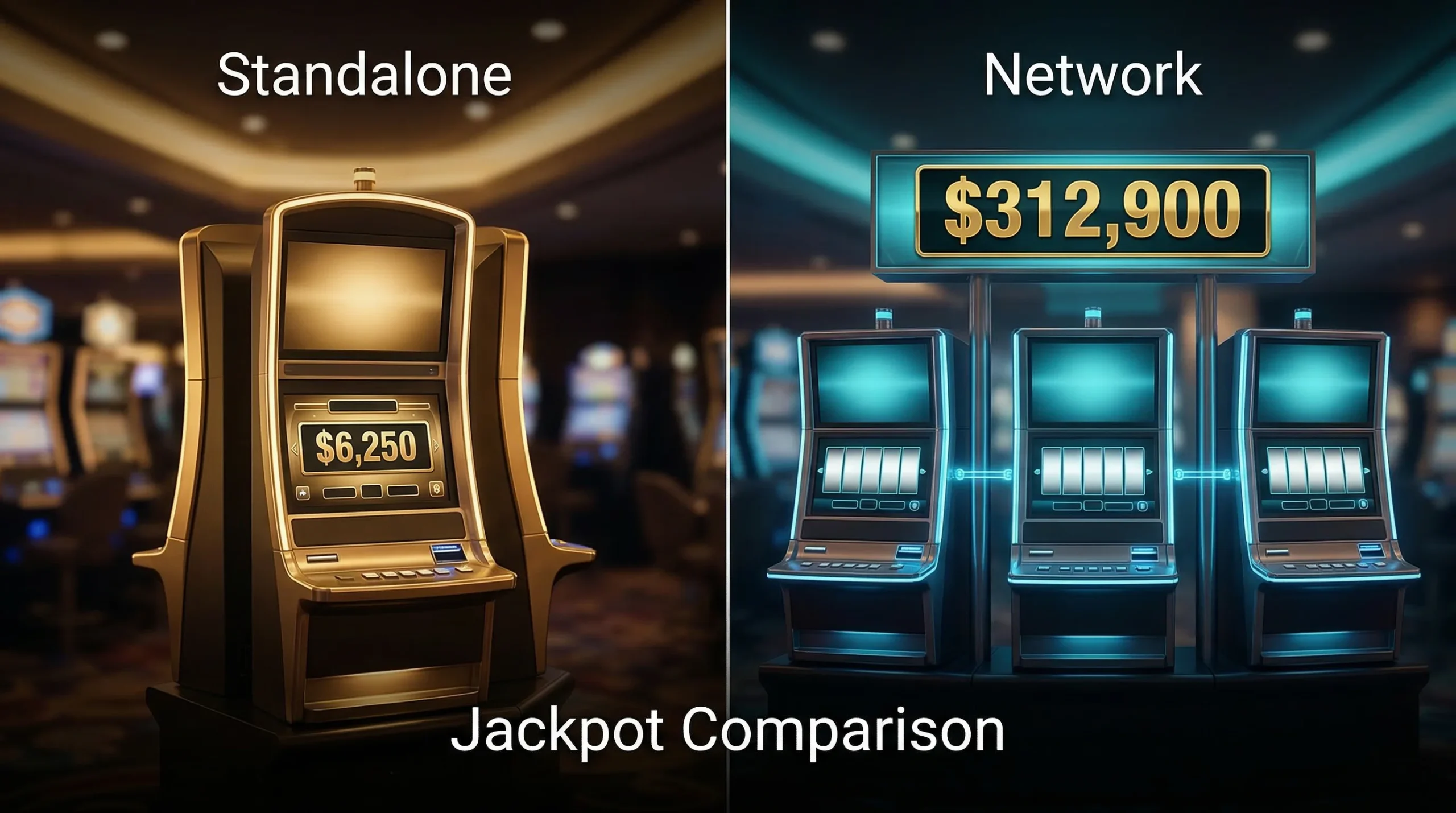
Progressive jackpots at sweepstakes casinos come in two fundamental architectures: standalone progressives that exist within single games and network progressives that pool contributions across multiple titles. The structure you play determines jackpot size, win probability, and how your wagers relate to prize growth.
The sweepstakes casino industry generated $10 billion in sales during 2024, according to KPMG’s industry analysis. Both jackpot types contribute to this volume, serving different player preferences and bankroll levels. Understanding the tradeoffs helps match your play style to appropriate games.
Neither structure is inherently better. Standalone progressives offer more achievable wins with smaller prizes. Network progressives offer larger prizes with longer odds. Your priorities determine which tradeoff serves you better.
Standalone vs Network Progressives — More on this topic at progressive sweep slots.
What Are Standalone Progressives?
Standalone progressives maintain jackpot pools tied exclusively to individual games. When you play a standalone progressive slot, your wager contributions feed only that game’s jackpot. No contributions arrive from other games, and no one playing elsewhere competes for your jackpot.
The isolation creates transparency that network progressives cannot match. The jackpot meter shows exactly what you are competing for, and the rate of growth reflects activity on that specific game. Rapid meter movement suggests high competition; slow growth suggests fewer active players.
Prize sizes on standalone progressives tend toward modest amounts. With contributions coming from only one game, jackpots accumulate slowly. A standalone might take weeks or months to build what a popular network progressive accumulates in days. Players seeking six-figure or larger jackpots rarely find them in standalone formats.
Win probability relative to contribution favors standalone progressives. Fewer competitors mean better individual odds even though absolute probability remains low. The jackpot that grows slowly also triggers more often relative to the spins feeding it. This mathematical relationship makes standalones attractive for players who prioritize realistic win chances over maximum prize potential.
Game selection in the standalone category may feel limited. Platforms invest development resources more heavily in network systems that can aggregate player activity across titles. Standalones often appear in simpler game designs or as secondary jackpot tiers within games that also offer network prizes.
The experience of playing standalone progressives differs psychologically from networks. You compete against a defined, visible pool with comprehensible dynamics. The jackpot belongs to the game you are playing rather than to a vast network you cannot see. Some players find this focus more engaging than chasing abstract network prizes.
What Are Network Progressives?
Network progressives pool contributions from multiple games into shared jackpots. Your wager on one linked slot contributes to the same prize pool as players spinning different linked slots. This aggregation accelerates jackpot growth and enables the massive prizes that attract attention.
Network scope varies significantly. Some networks link games within a single sweepstakes casino. Larger networks span multiple platforms, combining player activity across separate brands. VGW paid out $2.83 billion in sweepstakes prizes during fiscal year 2023-24, with network progressives contributing substantially to those payouts through their scale.
Prize sizes on network progressives can reach substantial amounts because more players contribute more frequently. The pooling effect means jackpots grow faster than any single game could support. The largest network jackpots offer prizes that transform winner circumstances in ways standalone prizes cannot.
Competition expands proportionally with network size. The same aggregation that builds large prizes also multiplies competitors. Your individual odds of winning a network progressive are lower than equivalent standalone odds because more people want the same prize. The mathematics require this relationship: larger prizes demand more contributions from more players.
Transparency decreases as networks grow. You see the jackpot amount but cannot easily assess how many competitors you face across linked games. Activity on titles you have never encountered affects your odds. This opacity complicates any strategic analysis that standalone progressives would permit.
Multi-tier structures commonly appear in network systems. The same game might offer a standalone Mini jackpot, a network-linked Major, and a wide-area Grand. This layering provides multiple win opportunities at different probability and prize levels within single sessions.
Odds Comparison
The fundamental tradeoff between standalone and network progressives centers on odds versus size. Standalone progressives provide better individual win probability for smaller prizes. Network progressives provide larger prizes with proportionally longer odds. Mathematical expected value may be similar; the distribution of that value differs dramatically.
Consider concrete examples. A standalone progressive might average $5,000 prizes with one winner per 500,000 spins across all players. A network progressive might average $500,000 prizes with one winner per 50,000,000 spins. The expected jackpot value per spin is identical, but individual experiences diverge completely.
Session-level analysis favors standalones for most players. If you play 1,000 spins per session, standalone odds of perhaps 0.2% create plausible win scenarios. Network odds of 0.002% create near-zero probability within typical sessions. The standalone offers something you might actually experience; the network offers a lottery ticket.
Lifetime analysis changes the calculation for heavy players. Someone playing millions of spins over years might rationally prefer network progressives because the larger prize becomes meaningful across sufficient attempts. This calculation applies to very few players and requires bankrolls that can sustain extended play through inevitable losing streaks.
Volatility implications accompany the probability differences. Standalone progressives add moderate variance to sessions. Network progressives add extreme variance where baseline expectation is zero jackpot wins for most players ever. The experience of playing network progressives involves accepting that you will almost certainly never win the jackpot you are chasing.
Which Should You Play?
Your bankroll should guide structure selection more than abstract preference. Playing high-variance network progressives with limited funds produces predictable disappointment. The mathematics guarantee that most underfunded players will exhaust their balance before favorable variance arrives. Matching bankroll to volatility improves outcomes regardless of which structure you prefer theoretically.
Entertainment value deserves consideration alongside probability analysis. Some players genuinely enjoy chasing massive jackpots regardless of odds. The excitement of pursuing a life-changing prize provides value that mathematics cannot capture. If network progressives make sessions more enjoyable, that enjoyment has worth even when jackpots never hit.
Standalone progressives suit players who want occasional wins that supplement regular gameplay. The more frequent, smaller jackpots provide positive feedback that sustains engagement. Players who find extended losing streaks demoralizing should favor the steadier reinforcement standalones provide.
Many players use both structures, selecting based on session goals and mood. Standalone progressives when seeking achievable jackpot opportunities; network progressives when feeling optimistic about long-shot possibilities. The structures complement rather than compete, serving different purposes within progressive play overall.
Platform availability constrains choices regardless of preference. Some sweepstakes casinos emphasize network progressives that leverage their large player bases. Others specialize in standalone offerings. Matching preferred structure to platforms that emphasize it requires research into specific catalogs before committing to any single site.
Choosing Your Jackpot Strategy
Standalone and network progressives serve different player goals through different mathematical structures. Standalones offer achievable wins with modest prizes. Networks offer massive prizes with lottery-ticket odds. Neither is objectively superior; each optimizes for different outcomes.
Understanding these tradeoffs helps set appropriate expectations. Standalone players should expect occasional small wins. Network players should expect no wins while enjoying the pursuit. Mismatched expectations produce frustration that proper understanding prevents.
The choice between structures ultimately reflects personal priorities about probability, prize size, and entertainment value. Players who know what they want can find games that provide it. Those who understand both structures can use each appropriately within their broader sweepstakes casino activity.